
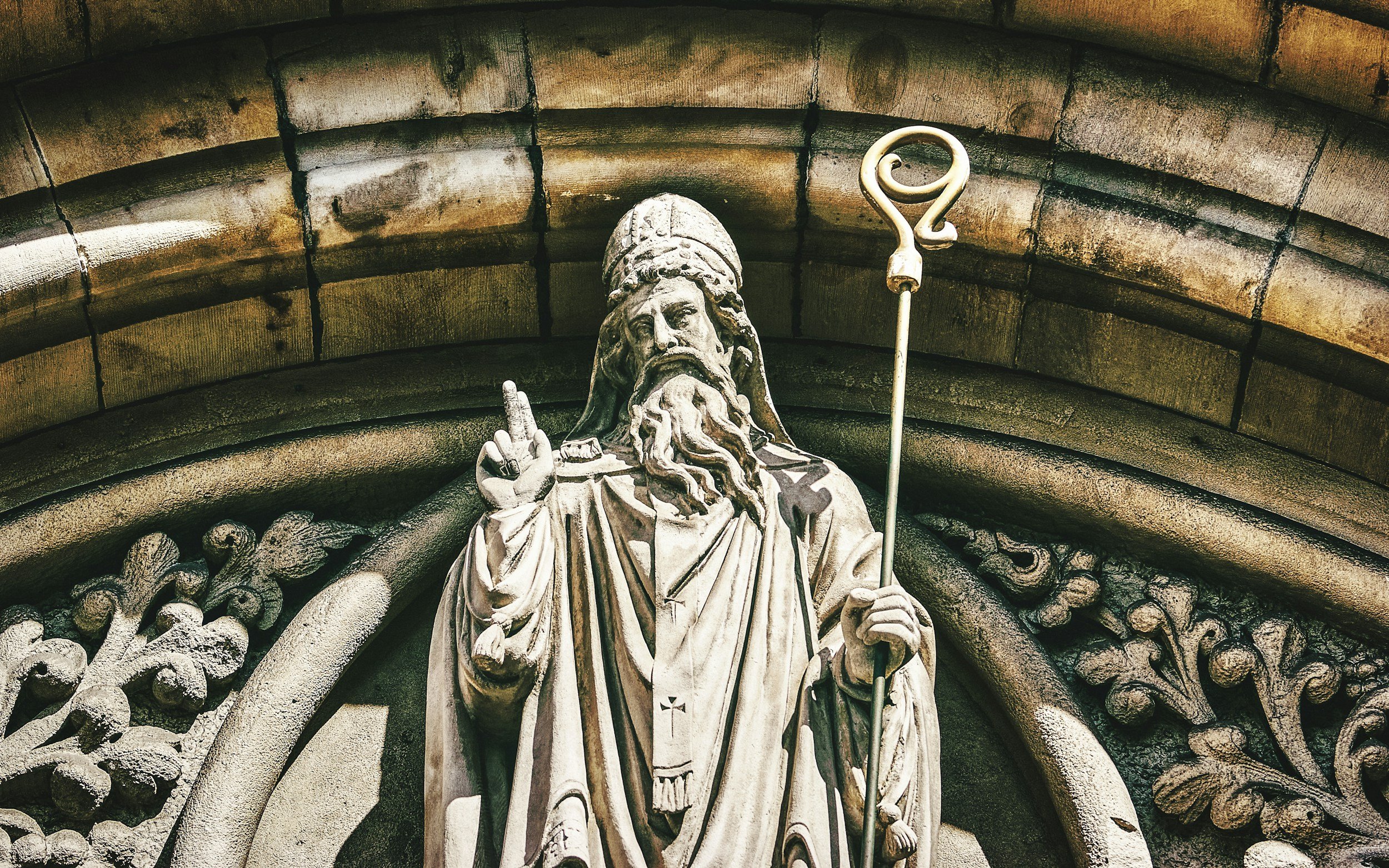
Today the idea of divine judgment is not only unacceptable to many people in the world. It is also often avoided by many people in the church as well.
However, even a quick read of the writings of St Patrick reveal that this one idea was central to his life, message, ministry and mission. If we lose it today, we not only lose the beloved Patron Saint of Ireland, but more importantly we lose the gospel he proclaimed.
For example it was a realisation of the need for justice that first alerted the young Patrick to his own need for forgiveness. As he ruminated about the role of justice as a slave, tending sheep on the hillsides of Ireland, he was strangely convicted by his own need for forgiveness.
“After I came to Ireland, every day I had to tend sheep, and many times a day I prayed… The love of God and his fear came to me more and more, and my faith grew.”
Eventually he explains that he saw plainly that without forgiveness for his sins, he would face the judgment of God with nowhere to hide.
“The Lord opened the understanding of my unbelieving heart, so that I should remember my sins and turn with all my heart to the Lord my God.”
There ought to be no surprise here for us. Repeatedly when we turn to the Bible, the theme of judgment is writ large. However, this theme of judgment is employed in various ways throughout the Bible and one particular way it landed with Patrick was as a motivation to mission! It did indeed bring him to a deep conviction of his own sin. But it did not stop there. It was this same message of judgment that then led him to live his life as a missionary among the very people who had originally enslaved him.
In other words the threat of eternal judgment did not harden Patrick into a critical and censorious priest. It softened him to the point where he was prepared to hold nothing back for the sake of loving God and loving his neighbour.
We see this played out in a story Mark includes in the middle of his Gospel.
Sitting ‘opposite the treasury’ Jesus watched as people placed their offering into the box in Mark Chapter 9:41. Then calling his disciples to him he explained that one individual stood out. Plenty of people were giving what they could afford, but a poor widow, (Mark 9:44)
‘put in everything she had, all she had to live on’
In context, the story of this widow is not simply meant as an example of being generous, though she certainly was. Her story is of far greater significance. The surrounding chapters are all actually about judgment. Jesus passes judgement on an empty hypocritical religion in Chapter 11&12 and carries this through to explain that the whole world is under the sentence of judgment in Chapter 13. And in the midst of such devastating and inescapable news we see this poor widow.
She stands out, not simply because of her giving, but as an example of someone who was holding nothing back. She may have been poor in worldly terms, but she was rich in terms of heaven.
It makes perfect sense; if this whole world is under the sentence of judgment, why would we live for anything this world can offer?
The message of inevitable judgment is not a message that the world alone needs to hear. It is also a message that the church needs to treasure.
This was the message that Patrick treasured and it was the same message that drove him forward in his ministry.
In fact the reality of judgment stayed with him, all through his ministry and was on his lips as he died.
“And this is my confession before I die. I give thanks to my God… who kept me faithful in the day of my temptation, so that today I may confidently offer my soul as a living sacrifice to Christ my Lord, who will judge the living and the dead.”
The message of judgement is of course unacceptable to the world. In Irish Church Missions we want to work hard to ensure that it remains central in the church. Without it our entire basis for mission is completely lost. We will certainly never risk everything in order to reach anyone. This St Patrick’s Day pray with us that judgment remains central to our gospel and therefore to our life.